
Made withHyperBlog
Documentation Testing in CI: Links, Examples, Style, and Accuracy

AI Documentation Generator: Capabilities, Limits, and Workflow
GitHub-Synced Documentation Tools: 8 Checks Before You Buy
An API documentation checklist should prove that a qualified developer can understand the contract, authenticate safely, make a successful request, interpret failures, and adapt to change. A polished endpoint list is not enough. The release gate needs evidence for reference completeness, runnable examples, error behavior, version scope, and accountable technical review.
Use this checklist before launching a new API, adding endpoints, changing authentication, or publishing a new version. It is designed as an acceptance test for SaaS API documentation. It does not replace a general product documentation checklist or a documentation CI pipeline. Those neighboring workflows cover the wider content lifecycle and automated quality checks.
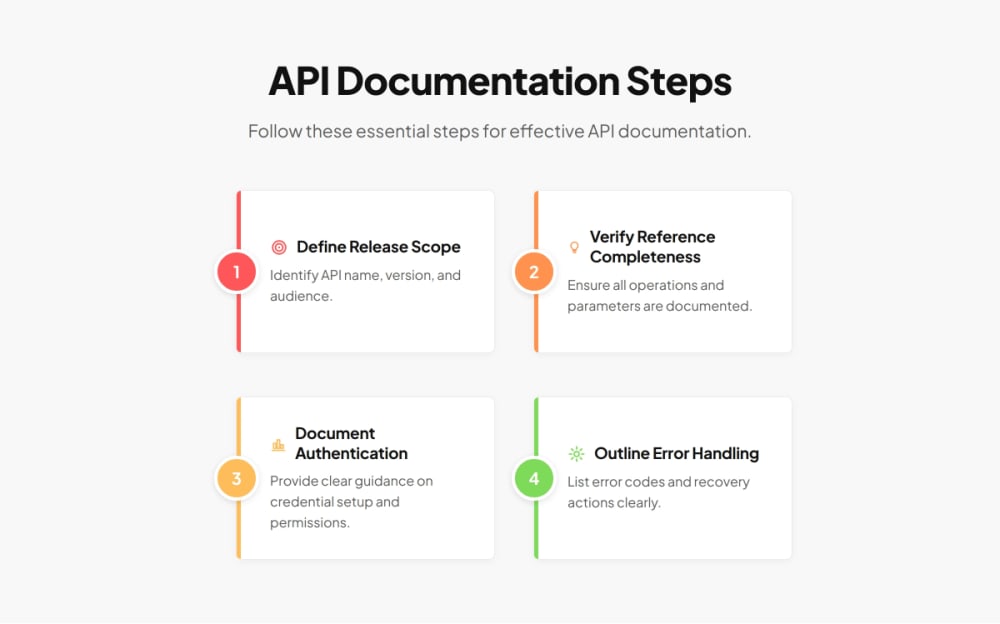
Before reviewing individual pages, define exactly what is being released. Record the API name, version, base URLs, supported environments, authentication model, intended developer audience, and the date the documentation was checked. Identify whether the release covers a public API, partner API, internal service, webhook, SDK, or a combination.
Name one source of truth for the contract. For an HTTP API, that may be an OpenAPI description maintained with the implementation. The OpenAPI Specification defines a language-agnostic interface description that lets people and software understand an HTTP API without reading its source code or inspecting traffic. The description still needs governance, examples, and human explanation around the contract.
Set exclusions in the release record. If one endpoint group, legacy version, beta feature, or partner-only flow is not included, say so. An explicit boundary prevents reviewers from approving a small sample while readers assume the whole API is covered.
Every published operation should identify its method, path, purpose, permissions, parameters, request body, responses, and version scope. The reference should state which fields are required, optional, nullable, read-only, or write-only. Define formats, allowed values, defaults, length or range constraints, and relationships between fields where the schema alone is ambiguous.
Check that operation names and identifiers are stable and meaningful. Readers should be able to distinguish similar actions without decoding internal service names. Reuse shared schemas deliberately, but do not make developers chase several references to understand one common request.
• Every public operation appears once under the correct path and method.
• Base URLs and environments are labeled, including sandbox and production differences.
• Path, query, header, and cookie parameters include type, requirement, constraints, and examples.
• Request and response schemas identify required fields, enums, formats, and null behavior.
• Each operation lists success and meaningful failure responses.
• Pagination, filtering, sorting, expansion, and field selection rules are explained consistently.
• Webhooks describe event names, payloads, delivery behavior, retries, verification, and ordering limits.
• The rendered reference is checked against the contract used by the running service.
Automated schema validation can catch invalid references and structural defects. It cannot confirm that the described business rules, permissions, defaults, and edge cases match production. Treat a valid schema as evidence for review, not as the final approval.
Authentication documentation should take a new developer from access request to the first authorized call without exposing secrets or leaving permission behavior to guesswork. Name the supported method, where credentials come from, how they are transmitted, how long they remain valid, and how they are rotated or revoked.
If the API uses OAuth 2.0, document the applicable grant or flow, authorization and token endpoints, scopes, redirect requirements, token lifetime, refresh behavior, and failure responses. Avoid presenting every OAuth flow as interchangeable. The OAuth 2.0 authorization framework defines distinct roles and grant patterns, so the published instructions should match the flow the product actually supports.
• A first-time developer can obtain test credentials using the documented account and permission prerequisites.
• Examples use placeholders and environment variables rather than realistic secrets.
• Scope names are explained in terms of allowed actions and protected resources.
• The docs distinguish authentication failure from an authenticated request that lacks permission.
• Rotation, expiration, revocation, and compromised-credential procedures are documented.
• Sensitive operations identify any additional approval, role, or step-up requirement.
Security review should inspect more than the happy path. OWASP’s API Security project highlights recurring risks such as broken object-level authorization and broken authentication. Documentation must not promise access controls that the service does not enforce, and examples should never normalize overprivileged credentials.
A useful example is complete enough to execute, small enough to understand, and accurate for the documented version. Include at least one successful request for the core workflow, then add examples for common variations and high-value failures. Show required headers, content type, request body, response status, response body, and the meaning of important fields.
Examples should use internally consistent identifiers, timestamps, currencies, pagination values, and resource states. If a request creates a resource and a later request updates it, the sequence should use the same example object. Avoid decorative payloads that satisfy the schema but teach nothing about the real workflow.
• A quickstart reaches one meaningful result with the fewest safe prerequisites.
• Copyable requests declare the base URL, authorization header, content type, and body.
• Success examples match the current schema and documented status code.
• Failure examples show a stable error shape and a practical recovery action.
• Code samples name tested language, SDK, dependency, and API versions.
• Destructive, billing, permission, and production-impacting examples use safe test resources.
• A reviewer runs or validates the examples against a controlled environment before publication.
Do not label pseudocode as a runnable sample. If a snippet omits setup, retries, validation, or cleanup for readability, state the omission. Developers should know whether they are seeing a minimum request, a production pattern, or a conceptual fragment.
Error documentation should help a developer decide what happened, whether retrying is safe, and what action resolves the problem. List the status code, stable application error code, human-readable message, relevant field or resource, and any request or trace identifier available to support.
HTTP status semantics provide the protocol layer, but the API must document its application behavior. For example, authentication challenges, authorization failures, validation problems, missing resources, conflicts, rate limits, and server failures need distinct recovery guidance when the service distinguishes them.
• The reference lists every expected error class for each operation, not only a generic default.
• The same application error code has one meaning across endpoints.
• Validation errors identify affected fields without returning secrets or unsafe internal detail.
• Rate-limit documentation states the measured unit, relevant headers, reset behavior, and recommended backoff.
• Retry guidance distinguishes transient failures from permanent request problems.
• Idempotency behavior is documented for operations that may be repeated after a timeout.
• Support guidance explains which request identifier and sanitized evidence to provide.
Developers need to know which version they are reading and what will happen when the contract changes. State where version information lives, how long versions are supported, which changes are considered breaking, how deprecation is announced, and where migration guidance appears.
For each breaking change, document the old behavior, new behavior, affected operations or fields, required developer action, test method, and enforcement date. Keep release notes connected to the relevant reference and guides. A changelog entry that says an endpoint changed without linking to the new contract leaves the implementation work unresolved.
• Every page and example makes its applicable API version clear.
• Deprecated operations and fields show the replacement and planned removal date when known.
Share your confidence level regarding your current API documentation process.
How would you rate your confidence?
• Breaking changes have a migration path and testable acceptance criteria.
• Old links continue to resolve or redirect to an appropriate version notice.
• The reference, guides, examples, SDK docs, and changelog agree on the release state.
• Preview or beta behavior is labeled with limitations and change expectations.
Review the documentation as a connected journey. Start with a qualified test account that has no undocumented setup. Follow discovery, access, authentication, first call, common workflow, failure recovery, and change awareness. Record each point where the reviewer must ask an internal team member or infer behavior.
Run automated checks for schema validity, broken links, example syntax, required metadata, and site builds. Then perform task-level review against a sandbox or controlled test environment. The final gate should include both machine evidence and accountable human approval.
Assign review by risk. Engineering should verify the contract and executable behavior. Security should review authentication, authorization, secrets, and sensitive examples. Product should confirm supported use cases and version scope. Technical writing or developer experience should test clarity, navigation, terminology, and task completeness.
Use the following release decision as a final pass. A failed high-risk item should block publication until it is corrected or an accountable owner accepts a documented exception.
1. Scope: audience, API version, environments, inclusions, exclusions, and source contract are recorded.
2. Reference: operations, parameters, bodies, schemas, responses, permissions, and constraints are complete.
3. Authentication: credential setup, scopes, token lifecycle, failures, and safe handling are actionable.
4. Examples: core requests run in a controlled environment and match the current contract.
5. Errors: stable error meanings, recovery actions, retries, rate limits, and identifiers are explained.
6. Change: version policy, deprecations, migrations, and release notes agree with the reference.
It should verify reference completeness, authentication and permissions, runnable examples, error behavior, version scope, automated quality checks, and accountable technical review.
Engineering should verify the contract and executable behavior. Security, product, technical writing, or developer experience should review the areas that match the release risk.
Each operation should document its method, path, purpose, permissions, parameters, request body, response schemas, meaningful errors, constraints, and applicable API version.
Explain how developers obtain and transmit credentials, required scopes and roles, token lifecycle, expiration, rotation, revocation, and distinct authentication or authorization failures.
Run or validate examples in a controlled environment, confirm that requests and responses match the current contract, and label any omitted setup or production safeguards.
Repeat the relevant checks whenever authentication, permissions, schemas, errors, examples, environments, supported versions, or release behavior changes.
7. Quality: schema, links, examples, and site build pass the agreed automated checks.
8. Review: engineering and other risk owners approve the rendered developer journey.
9. Ownership: each documentation area has an owner and a trigger for future review.
10. Publication: canonical URL, navigation, search, metadata, analytics, and feedback paths are verified.
Hyperdocs provides an API documentation workspace for publishing API references, setup and authentication guides, code examples, and versioned developer content alongside product docs, a help center, and changelog. Its public product page also describes drafts, technical review, controlled publishing, API versioning, and an API Explorer for supported endpoints.
Hyperdocs does not currently claim OpenAPI or Swagger import as part of its initial API documentation experience. Teams should verify the live product behavior and keep their contract-validation workflow explicit rather than assuming an unsupported import or generation capability.
A strong API documentation release is not defined by page count. It is defined by whether a developer can complete important tasks safely and whether reviewers can trace each instruction to the current contract and running product.
Keep the checklist close to the API release workflow. Re-run the relevant checks when authentication, schemas, errors, examples, versions, or permissions change. That turns documentation review from a final editorial pass into an evidence-based product release gate.
Subscribe to Our Newsletter
Stay up to date with our latest news and updates.