
Made withHyperBlog
Best Help Center Software for SaaS Teams: Selection by Support Model

Best Documentation Platforms for SaaS Teams in 2026
Documentation Platform Migration Checklist: A Plan for Existing URLs
A multilingual product documentation workflow needs one accountable source page, a separate publish state for every language, and an explicit rule for what happens when the source changes. Translation is only one step. The durable system tracks ownership, terminology, product version, reviewer, publication status, and retranslation decisions for every locale.
This guide explains that operating model for SaaS documentation teams. It covers source ownership, change propagation, version parity, reviewer assignment, and practical acceptance tests. It does not replace a detailed translation quality checklist, evaluate multilingual answer systems, or compare localization vendors. Those are separate reader jobs.
Choose one source language and one canonical page for each customer task. The source page should be the place where the team confirms product behavior, examples, screenshots, links, and release applicability. A translation is a governed language version of that page. It should not become an independent copy that can drift without notice.
The source owner is accountable for meaning. This person does not need to translate every language, but must decide when a source change is ready for localization, which locales are affected, and whether the change is urgent. Assign ownership at a useful level, such as a product area or folder, and allow page-level exceptions for regulated or high-risk content.
Keep a locale registry beside the documentation inventory. At minimum, record:
Use standard language tags consistently. The W3C recommends declaring the page language with the HTML lang attribute and choosing tags from the IANA registry under BCP 47. Region or script subtags should be added only when they distinguish content that actually differs.
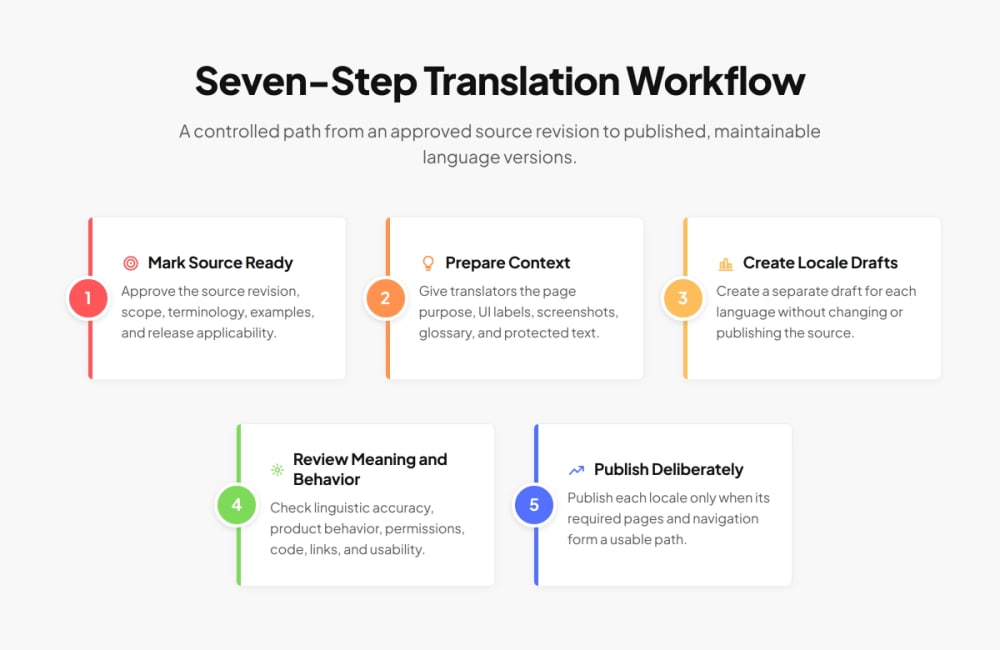
Do not start translation from an unstable draft. The source owner should confirm the customer task, supported product version, terminology, examples, and links. Record the source revision or content version that translators will use. If the product behavior is still changing, leave the page in source review instead of asking every language team to chase edits.
A release deadline may require staged localization. In that case, identify the smallest stable section, translate it, and record the remaining source sections as out of scope. This is more reliable than presenting a partially current translation as fully aligned.
Give reviewers more than isolated sentences. Provide the product area, intended reader, page purpose, screenshots, UI labels, code context, and links to related pages. Mark text that must stay unchanged, including code, variables, commands, brand names, and legal wording.
Maintain a product termbase with the approved source term, definition, target-language term, prohibited variants, and owner. Microsoft’s localization guidance recommends managing terminology early because consistent terms improve product, documentation, and marketing content. A termbase also prevents different translators from inventing different names for the same control.
Machine translation can create a first draft, while a human translator can begin from the same approved source. In both cases, the output should enter a draft state and retain its relationship to the source revision. Creating a translation must not modify the source page or automatically make the target language public.
Keep drafts separate by locale. French for France and French for Canada may share much of their language, but product terminology, legal notices, currency, date formats, and support routes can differ. Decide whether those differences justify separate locale versions before publishing.
Use two review lenses. A language reviewer checks meaning, terminology, tone, grammar, and cultural fit. A product reviewer checks behavior, permissions, versions, code, screenshots, links, and task completion. One person may cover both roles for a small team, but the approval record should state which lens was completed.
Review the page in context. Verify navigation labels, headings, tables, callouts, code blocks, error messages, and screenshots in the rendered preview. A sentence can be accurate by itself and still be misleading when a button label, image, or prerequisite remains in the source language.
Publish a language only after its required pages and navigation form a usable path. A localized home page that leads into untranslated setup steps can create more confusion than a clear fallback to the source language. Define a minimum launch set for each locale, such as onboarding, account access, billing, common errors, and contact paths.
Hyperdocs supports separate translation, draft, publication, and visibility states for each language. Its current documentation also says the English source remains unchanged and a retranslation replaces only the selected language copy after confirmation. These controls support the source-and-variant model described here.
Check the public URL, language selector, page language declaration, canonical behavior, alternate-language annotations, search indexing, and fallback behavior. Confirm that links stay in the selected locale when a translation exists and clearly handle the case when it does not.
Google recommends telling Search about localized versions with hreflang and using a separate URL for each language version. Every localized page should identify its counterparts, including itself. Treat this as a publishing acceptance test rather than an SEO task added after launch.
Every approved source change needs an impact decision. Classify the change as editorial, terminology, behavioral, structural, visual, or release-specific. Then mark affected locales as current, review required, or retranslation required. The decision and reason should remain visible to the next reviewer.
Choose the part of the workflow that creates the most maintenance risk for your team.
Which part of multilingual documentation is hardest to keep current?
Avoid automatically overwriting approved translations. A source sentence may have changed for clarity while the existing target text is still correct. A reviewer should compare revisions, preserve valid local edits, and approve the new version. Automatic replacement is appropriate only for low-risk content under a documented policy.
A clear workflow names who can change the source, who translates, who reviews the language, who verifies product behavior, and who publishes. Use role names that fit your organization, but keep the decisions separate.
For documentation stored in Git, ownership rules can request reviews from the responsible team. GitHub’s CODEOWNERS feature, for example, can define individuals or teams responsible for paths and can be paired with required approval. The broader principle also applies outside Git: route each page to a named owner based on product area.
Treat source changes as work items with a destination, priority, and owner. Each change event should identify the affected page, source revision, changed sections, change class, release date, target locales, and expected action. The localization queue should be searchable by language, product area, status, and release.
Use service levels based on customer risk. A security instruction, breaking API change, or account-access procedure may require same-release localization. A style improvement can wait for the next planned review. Document the fallback for each priority, such as keeping the older translation visible with a version notice, hiding the page, or sending readers to the current source language.
Connect this queue to the product release process. When a change affects documentation, the source owner should decide whether translated pages are also release blockers. The decision belongs in the launch record, not in an informal message that disappears after the release.
Parity does not mean every language always has the same number of pages. It means readers can tell which product version a page supports and the team can identify where language versions differ. Maintain a matrix of page, locale, source revision, product version, translation status, and publication date.
Define acceptable lag by content type. Setup and account-access pages may need near-simultaneous publication. Long reference pages may follow in a later localization batch if the fallback is clear. Archived product versions should keep their language status rather than inheriting the current version’s approval.
When a translated page falls behind, make the state visible internally and choose a reader-facing response. Options include a version notice, a link to the current source, or temporary removal from navigation. Do not silently present an old translation as current.
It is the canonical source-language page and approved revision that defines product behavior, scope, examples, and release applicability for every locale.
Usually no. Each locale should enter a draft state and pass the required language and product reviews before it becomes visible to readers.
Track the source revision behind every locale, classify each approved source change, and route affected language versions into a visible review or retranslation queue.
A language reviewer should verify meaning and terminology, while a product reviewer should verify behavior, versions, permissions, code, links, and task completion.
It means the team and readers can identify which product version each locale supports and where a translation differs from the approved source, even when release timing varies.
Compare the new source revision with the approved translation, preserve valid locale-specific edits, and replace them only when a reviewer confirms the change is necessary.
A release review should sample terminology, UI strings, links, code blocks, screenshots, metadata, language direction, and the task’s final outcome. The full QA checklist deserves its own process because it changes by content type and language. In this workflow, the important rule is that each failed check creates an owned correction before publication.
Use a risk-based sample when volume is high. Review every page that covers billing, security, access, data loss, breaking changes, or regulated behavior. Sample lower-risk explanatory content and expand the sample when defects repeat. Record both the defect and the source of the defect, such as an unclear source sentence, an outdated screenshot, or an incorrect term.
Measure the system’s ability to keep language versions trustworthy. Useful indicators include source-to-translation lead time, share of public pages aligned to the approved source revision, open high-risk changes, review turnaround, terminology defects, broken localized links, and pages with no assigned owner.
Segment results by locale and product area. A single average can hide a language that routinely misses releases or a product area that sends unstable source content. Use the measures to change capacity, source quality, review rules, or launch scope. Do not turn them into translator performance scores without context.
Test a documentation platform with a small but realistic release. Update one source page, translate it into two languages, preserve a locale-specific edit, route each draft to a reviewer, publish one language, keep the other hidden, change the source again, and verify that the system identifies the affected versions without silently replacing approved work.
Check the public output as well as the admin workflow. Verify separate URLs, language selection, language metadata, links, search behavior, version notices, and fallback. Record which actions are automatic, which need approval, and which evidence the platform retains.
Hyperdocs provides multilingual drafts, separate publication controls, language visibility, manual editing for Docs and Changelog translations, and confirmed retranslation behavior. Review the live product page and setup guide against your own roles, locale plan, and release requirements before adopting the workflow.
A reliable multilingual documentation program protects meaning as product information moves across languages and releases. Start with a canonical source, give every locale an explicit state, assign reviewers by responsibility, and route each source change through a visible queue. That creates a system the team can operate, audit, and improve as the product and audience grow.
Subscribe to Our Newsletter
Stay up to date with our latest news and updates.