
Made withHyperBlog

Best Documentation Platforms for SaaS Teams in 2026
Documentation Platform Migration Checklist: A Plan for Existing URLs
Multilingual Product Documentation: Translation and Source-of-Truth Workflow
The best help center software for SaaS depends on how your team delivers support. Consider Hyperdocs when public help content needs to stay connected to product documentation, Help Scout when articles should sit close to an inbox, Intercom when conversations and in-product support lead the experience, Zendesk when a broader service operation needs multiple channels, and Document360 when editorial governance is the central requirement.
Start with the support model you need to improve, then shortlist two products. A searchable article library, an agent inbox, and a customer-service suite solve related problems, but they create different ownership and cost commitments. Buying a larger suite will not automatically repair an unclear answer or establish who updates it after a release.
This is a source-based editorial comparison checked on October 28, 2026. We reviewed official product documentation and pricing for five different operating models. The recommendations describe documented fit and questions to validate. They do not represent a hands-on benchmark, customer survey, or numerical ranking.
Publisher disclosure: Hyperdocs publishes this article and is one of the products considered. Apply the same acceptance criteria to it as to every other candidate. Prices below are in US dollars, with billing basis and promotions identified where relevant. Confirm the current quote, included usage, and required plan before purchase.
The scope is customer-facing SaaS help content and its connection to human support. Internal employee knowledge, API-tool rankings, and a full procurement scorecard are separate decisions. For the latter, use the existing knowledge base software requirements guide.
Knowledge base software requirements and acceptance criteria
Product | Shortlist for | Validate first |
Hyperdocs | Public help connected to product documentation |
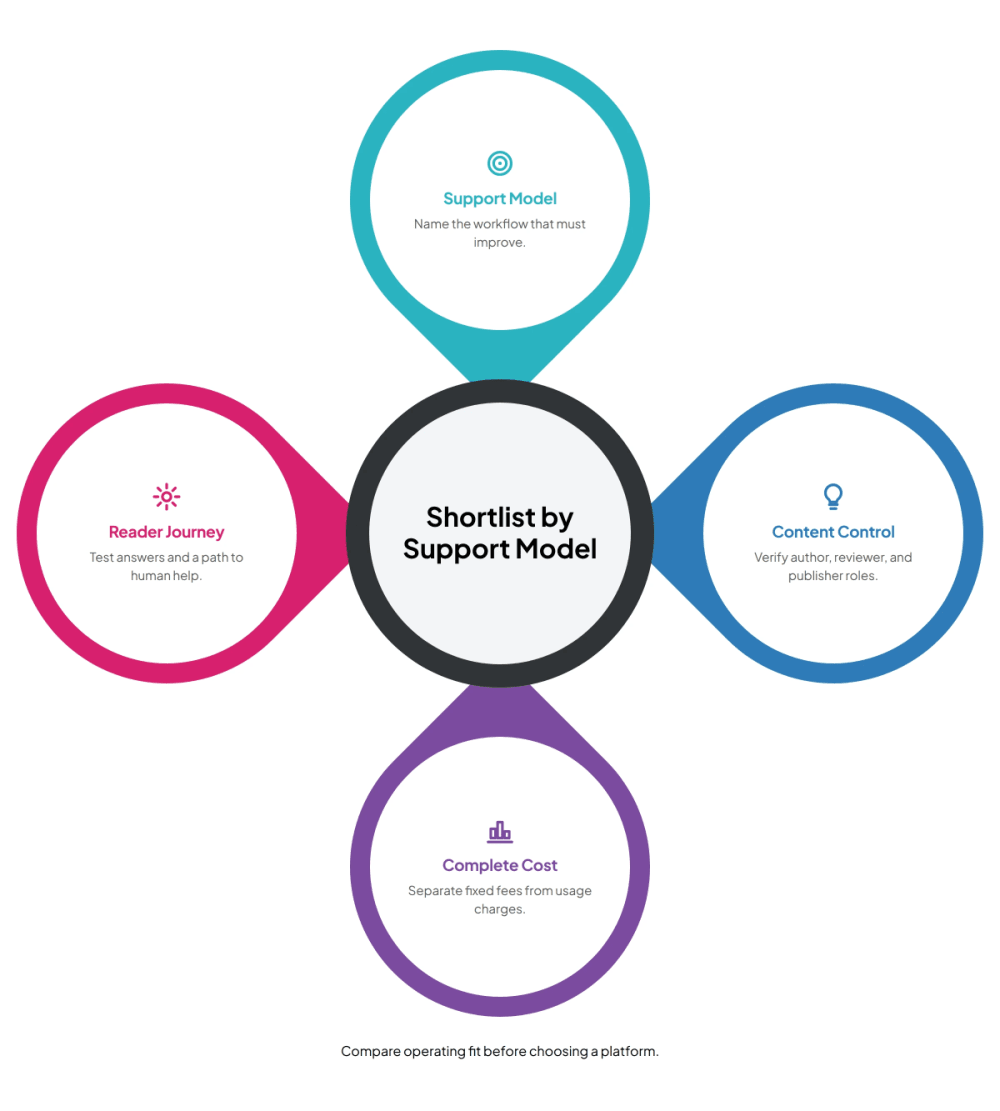
These are starting points rather than exclusive categories. Several products may fit the same support organization. The useful question is which operating model removes a current constraint without introducing work your team cannot own.
Hyperdocs is worth evaluating when product guides and support answers need a shared maintenance process. Its help-center offering includes organized topics, searchable articles, feedback, and Answer Agent responses grounded in published documentation. Treat answer quality as something to test against your approved content, rather than assuming an AI feature makes every response correct.
A practical fit check is a product change that affects both a setup guide and a troubleshooting answer. Ask your documentation owner to identify the affected content, prepare corrections, obtain review, and verify the published result. Keep security-sensitive and account-specific cases in a human support path.
Current annual-billing prices are Starter at $39, Growth at $99, and Scale at $169 per month. The site offers a 14-day free exploration period. Credits, team allowances, approvals, and analytics differ by plan; Growth lists stronger search and Answer Agent analytics. Confirm your required configuration rather than equating the entry price with the entire support operation.
Hyperdocs current pricing, credits, and plan limits
Connect Help Content to Your Product
Explore Hyperdocs’ public help center, search, and answers from approved documentation.
Consider Help Scout when the team wants its help articles close to everyday customer conversations. Its Docs offering publishes a knowledge base, and Beacon can bring articles into a website or product. The documented ability to reuse articles in replies makes it a candidate for support teams that want a connected publishing and inbox workflow.
Help Scout knowledge base and Beacon overview
Source highlight: Help Scout distinguishes user-based billing from contact-based accounts in its own billing documentation. Existing account terms can therefore differ from a new-customer price page. Confirm which model applies before comparing bills.
Help Scout billing and plans guide
With annual billing selected, the current pricing page lists Standard at $25, Plus at $45, and Pro at $75 per user per month. A Free plan lists five users, one Inbox, and one Docs site. Envoy is a separate AI add-on listed at $0.75 per resolution. Check allowances, extra sites, and workflow controls for the package you need.
Help Scout current plans and AI charges
During evaluation, follow one article from a draft to a customer reply and then to an in-product help interaction. Inspect who can correct it, how a teammate finds the approved version, and what happens when an article is insufficient. A convenient inbox is useful only if the linked answer remains maintainable.
Intercom is a candidate when help articles, Messenger, and the support inbox need to work together. Its Essential plan includes a public help center, while private and multilingual help-center capabilities are listed under Advanced. Validate the required audience and language configuration before choosing a tier.
Source highlight: Intercom’s setup documentation says articles must belong to a collection to appear in help-center search. Publishing content and making it discoverable are separate checks. Its documentation also describes sharing articles in Inbox conversations.
Intercom help-center setup and collection behavior
The annual pricing view currently displays an Essential promotional price of $19 per seat per month beside a struck-through $29, with a new-customer offer. Advanced lists $85 and Expert $132 per seat per month. Fin starts at $0.99 per outcome. Confirm eligibility, contract terms, outcome definitions, and channel charges instead of treating the promotion as a permanent all-in price.
Intercom current seat prices, promotions, and Fin usage
Test a customer who starts with an article, asks a follow-up, and then needs a person. Check which context reaches the teammate and whether the customer must repeat information. That handoff should guide the decision more than the presence of an AI label.
Zendesk deserves consideration when the help center belongs inside a larger operation spanning ticket routing, messaging, and phone support. Its pricing distinguishes the $19-per-agent Support Team package from Suite Team at $55 per agent per month, paid yearly. Suite Team explicitly includes a knowledge base alongside messaging, live chat, and telephony.
That distinction matters: the lowest ticketing price is not automatically the cost of the help-center configuration. Suite Professional currently lists $115 per agent per month paid yearly, with additional capabilities. Verify the required knowledge features, AI usage, add-ons, and enterprise controls in the actual proposal.
Zendesk official plans and knowledge-base packaging
A useful evaluation follows one issue across channels without losing its identity or the article already suggested. Include your support administrator as well as an agent. The wider suite may be appropriate, but the team also needs capacity to configure and maintain the workflow it selects.
Document360 is a candidate when the hardest problem is moving a large help-content library through accountable review. Its Workflow designer documents custom statuses, assigned users or groups, read-only restrictions, and mandatory comments. Those are concrete controls to inspect when multiple subject-matter reviewers share publishing responsibility.
Source highlight: Document360 documents that a read-only workflow status prevents editing and publication while the article remains in that status. Test the intended approval path with actual writer and reviewer roles; a status label alone is weaker evidence than the action it permits or prevents.
Document360 Workflow designer controls
Document360 uses customized pricing. Request a quote covering the required contributors, workspaces, languages, reader access, analytics, and AI capabilities. Compare that configuration with the other finalists rather than filling a comparison table with an unverified starting-price estimate.
Document360 customized pricing
Choose it for evaluation when governance is a recurring operational constraint. Separately verify how support conversations and customer context enter your content backlog. A strong editorial process still needs an owner for discovering which answer is missing.
Build one purchasing scope for both finalists: publishing sites, paid teammates, reviewers, languages, access rules, expected AI usage, support channels, and ongoing administration. Separate the fixed subscription from variable outcome or resolution charges. Record annual commitments and the end of any introductory offer.
Model a normal month and a higher-demand month using your own volumes. Verify how each vendor bills reopened conversations, unsuccessful answers, and handoffs.
Keep essential requirements outside preference scoring. If the business needs restricted articles, contractual safeguards, or specific integration behavior, verify those conditions directly with the responsible vendor and reviewer. A polished public site is not evidence that a private workflow meets your policy.
Share the support workflow your team most needs to improve.
Which support model is your team's current priority?
First, use a routine question with a known answer. Let a customer-like tester find the article from your intended entry point and complete the task. Record the actual path and where help becomes necessary. Use the help-center navigation guide for detailed structure and findability work, rather than rebuilding that entire exercise into vendor scoring.
Design and test a navigable self-service help center
Second, use an exception that requires a person, such as an account-specific billing investigation. Inspect how the system communicates its limit, offers an appropriate next step, and preserves useful context. Do not turn a public help article into a substitute for authorized account access.
Third, change an instruction after a product release. Ask the content owner to correct the source, route the change for review, publish, and inspect the customer-facing article and answer. These are proposed evaluation tasks, not test results claimed for any vendor in this shortlist.
Before migrating a library, identify which pages should be retained, corrected, merged, or retired. The existing help-center content audit template provides that separate cleanup workflow.
Review existing articles with the help-center content audit template
Finish with two things you can inspect: a configuration that supports your support model and evidence from the people who will operate it. Choose from that evidence, keep the unresolved limitations visible, and assign ownership for maintaining the answers after launch.
Start with the main constraint: public content maintenance, knowledge alongside an inbox, conversation-led help, multichannel service, or governed article production. Shortlist candidates for that operating model, then verify the required configuration.
Potentially, but verify the connection rather than assuming it. Check article linking, search, contact paths, customer context, access rules, and ownership across the two systems before deciding.
Separate platform and seat fees from usage charges. Model expected demand, check how billable outcomes are defined, and confirm what happens when an answer fails, a conversation reopens, or a customer needs a person.
A free plan can support evaluation or a limited setup. The working configuration may require more contributors, sites, languages, analytics, approvals, or AI usage. Price the complete scope and ongoing administration.
The article uses official vendor product documentation and pricing checked on October 28, 2026. It discloses Hyperdocs as publisher and candidate. It does not claim a hands-on benchmark, customer survey, or universal winner.
Verify a routine self-service task, a case that requires human help, and a reviewed content correction after a product change. Inspect the actual public result and retain an accountable owner for future updates.
Subscribe to Our Newsletter
Stay up to date with our latest news and updates.
Content maintenance, published answers, required analytics plan |
Help Scout | Knowledge alongside a shared inbox | Article reuse, Beacon delivery, user and AI charges |
Intercom | Conversation-led and in-product support | Help-to-human handoff, audience rules, Fin outcomes |
Zendesk | A broader multichannel service operation | Knowledge package, routing, agent workflow and total cost |
Document360 | Governed article production | Review stages, writer access, publishing authority and quote |