
Made withHyperBlog
Docusaurus Cost Guide for SaaS Teams: Hosting, Search, and Maintenance
GitBook vs Mintlify for SaaS Teams: Editing, AI, and Total Cost

7 Best Docusaurus Alternatives for SaaS Documentation Teams
The best ReadMe alternatives depend on which part of your documentation needs to change. Consider Hyperdocs for product documentation tied to GitHub changes, GitBook for mixed-team editing, Mintlify for managed Git-based developer docs, Redocly for an API description-driven portal, Fern for a docs-and-SDK workflow, and Docusaurus for ownership of the site and hosting. Start by listing the ReadMe capabilities you must preserve.
A replacement can look attractive while removing something developers rely on: personalized API keys, request history, a working reference, or an established review process. Evaluate those dependencies before comparing themes or subscription prices.
This is a source-based shortlist for SaaS teams replacing public product or API documentation, checked against official documentation and pricing on November 7, 2026. The selection criteria are reader experience, authoring, API maintenance, publishing ownership, and operating cost. The pilot tasks below are recommendations, not completed product tests or performance benchmarks.
Publisher disclosure: Hyperdocs publishes this article and appears among the candidates. Muthukumar, Hyperdocs co-founder, is the author. There is no universal winner or numerical ranking; apply the same requirements and migration checks to every vendor.
ReadMe already offers an interactive API reference, bidirectional sync, and usage analytics on its Starter plan. Its Pro plan adds branching and reviews, private docs, and additional AI authoring features. Check the current ReadMe plan details before defining a gap. A feature you need may be available through a different configuration of your existing platform.
Its Developer Dashboard can expose personalized API keys and request logs after the required integrations. Pageview analytics in a replacement do not establish equivalent developer troubleshooting. If customers depend on those logs, name the replacement system, implementation owner, and additional cost before migration.
ReadMe also documents a GitHub AI Writer that proposes updates on review branches when pull requests affect documentation. Assess the actual update and approval workflow instead of assuming that leaving ReadMe is necessary to connect documentation with code changes.
Your main requirement | Candidate to evaluate | What the pilot must establish |
Product and help content maintained after releases | Hyperdocs |
These are starting points, not exclusive capabilities. Several products can meet the same requirement. Choose two finalists around the problem you need to solve, then compare them with the same content and acceptance criteria.
Hyperdocs deserves consideration when the documentation program includes product guides and help content as well as an API reference. Its GitHub Sync workflow identifies documentation impact and prepares suggested updates for team review. The published API Reference documentation describes structured endpoints, versions, code samples, and an optional Try It console.
For a ReadMe migration, inspect the exact API workflow you use today. Require evidence for specification import, request logging, personalized credentials, and any custom integration your team depends on; the presence of an API reference does not establish parity. Pilot a product change that affects both an onboarding guide and an endpoint explanation, then inspect the proposed edits and final public pages.
Compare Hyperdocs and ReadMe
Review documentation workflows, publishing options, and plan differences to decide whether Hyperdocs fits your team.
GitBook is a candidate when moving from ReadMe should improve participation across product, support, and engineering. Its bidirectional GitHub and GitLab sync supports edits from the visual editor and repository. That lets you evaluate a shared contribution model while preserving a Git-based authoring path.
Have a product writer revise a task guide while an engineer changes the associated example in Git. Check how the two edits are reviewed, reconciled, and published. Separately test the API reference and reader journey you need to preserve from ReadMe. A familiar visual editor is useful only if your required developer experience survives the move.
Mintlify is worth evaluating when Git should remain central to developer documentation without your team operating the whole publishing stack. Its editor documentation maps browser editing to branches, pull requests, review, and deployment. Incoming repository changes sync into the editor; competing edits need a defined resolution path.
Use a real specification sample and a product guide in the pilot. Confirm how an API change reaches the reference, who can review it, and what triggers publication. Price the required editing, automation, and reader-assistant features on the current plan. Neither Git synchronization nor a documentation assistant proves equivalent request-log visibility for your developers.
Redocly is a candidate when the reason for replacing ReadMe involves API descriptions, portal structure, or governance across an API program. Its platform documentation describes API references from OpenAPI, GraphQL, and AsyncAPI alongside written pages. It also documents branch previews, reviews, and API scorecards.
Build the pilot around your hardest specification rather than a small demonstration endpoint. Inspect reusable schemas, navigation, version selection, and the relationship between reference pages and task guides. Confirm the plan requirements for catalogs, access controls, analytics, and multiple projects. A broad portal platform can introduce configuration work that a small team must budget to maintain.
Fern deserves a place on the shortlist when developer onboarding depends on both readable documentation and maintained client libraries. Fern Docs supports written guides, generated API references, and an API Explorer. Its SDK workflow combines API specifications with generator configuration and custom code to produce client libraries.
Pilot an endpoint with a realistic request, a failure response, and a client-library example. Check how a specification change reaches the reference and the SDK release. Compare the effort of operating both deliverables, not just launching the website. Treat SDK packaging and documentation hosting as separate purchasing questions, and confirm their current scope and terms.
Docusaurus suits an engineering-owned approach when source portability and customization justify running the surrounding stack. It provides a React and MDX-based site with documentation features such as versioning and localization. Its deployment guide establishes the operating boundary: Docusaurus builds static files, and your team chooses how to host them.
Moving from ReadMe therefore means specifying more than a content importer. Identify the API-reference renderer, search service, analytics, access controls, and contributor workflow you will operate. Ask a nontechnical writer to complete a routine correction in that setup. Include hosting, dependency upgrades, build failures, and engineering support in the budget; an open-source site still needs an owner.
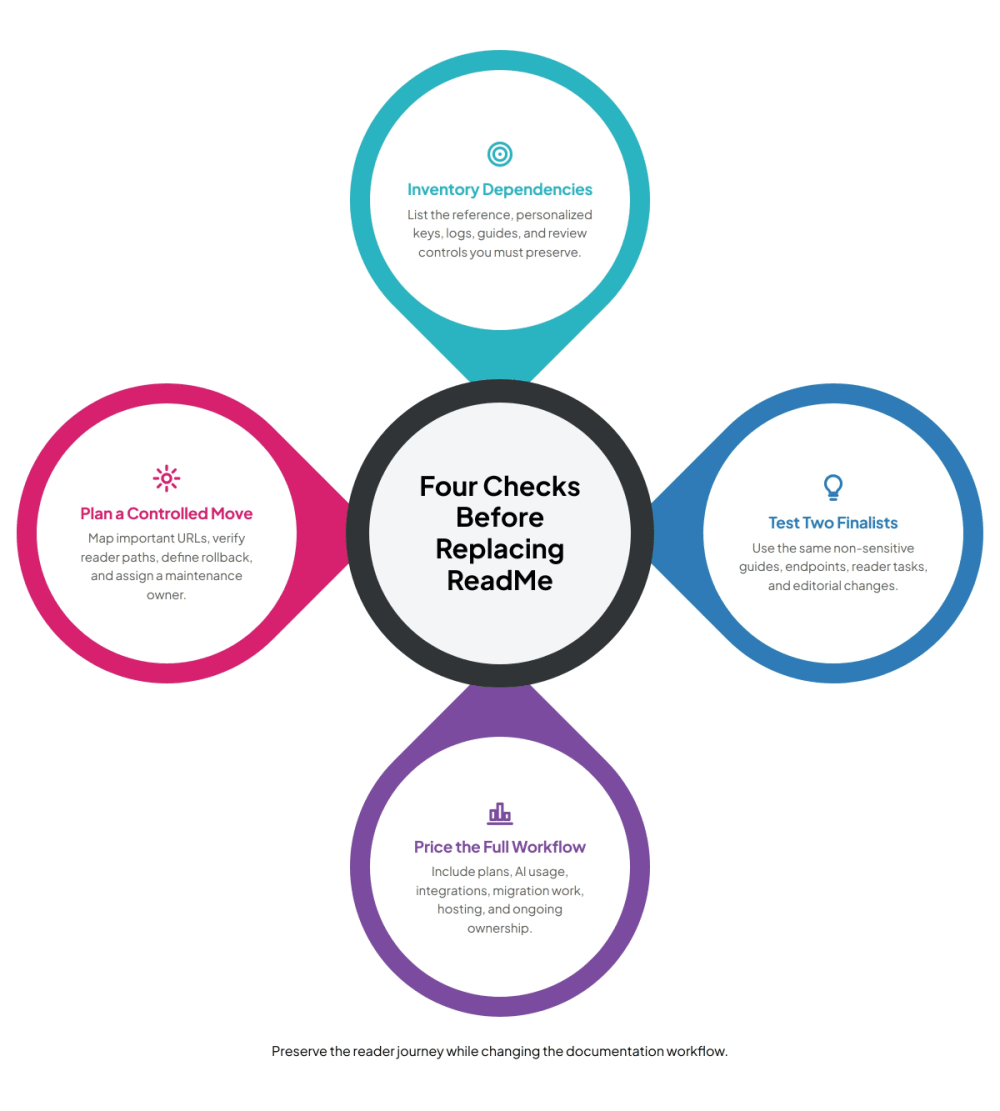
Price a specific configuration: sites, contributors, versions, reader access, AI usage, and any developer-log integration. As checked November 7, ReadMe lists Pro at $250 per month billed annually and full Ask AI as a $150 monthly add-on. Its Ask AI documentation distinguishes that add-on from Ask AI Lite, which is included on Pro and Enterprise. Do not charge your comparison for an add-on you do not need.
Request the same configuration from each finalist. Record hosting and search costs for a self-managed option, SDK costs where relevant, migration cleanup, and ongoing administration. Ask how AI allowances and overages work. Keep billing periods consistent, and separate a subscription saving from an unmeasured claim about lower support costs or faster onboarding.
Which requirement matters most in your next documentation platform?
What would drive your decision to replace ReadMe?
Give each finalist an approved, non-sensitive content set: a getting-started guide, authentication instructions, one representative endpoint, an error explanation, and a versioned release note. Have a developer follow the published path from setup to a successful sandbox request, then locate help for a failure. Use the API documentation checklist to define the content acceptance criteria.
Have a writer correct the guide and an engineer change the endpoint description. Record who can preview, review, merge, publish, and reverse the edit. Introduce one controlled product change and inspect what documentation work the platform identifies. Verify every generated draft against the source behavior before approval; fluent text alone is insufficient evidence.
Map important ReadMe URLs to intentional destinations. Check nested pages, images, code blocks, anchor links, metadata, redirects, and canonical URLs. Give each acceptance test an owner and a pass condition before the demo. The documentation migration checklist covers cutover and rollback planning once your finalist passes.
Select the ReadMe alternative that solves a documented problem while preserving the capabilities customers already use. Keep ReadMe in consideration if it meets those requirements with less migration work. The final decision should include a verified content sample, a complete cost model, a maintenance owner, and recorded limitations.
For a product-heavy SaaS, prioritize the path from a release to reviewed documentation. For an API-first company, prioritize the developer journey and the systems supporting it. A successful replacement leaves both readers and contributors with a workflow your team can maintain.
Start with the capability you need to change. Evaluate product-documentation maintenance, mixed-team editing, API governance, SDK delivery, or site ownership separately. Choose two candidates and test the same representative content.
Yes. ReadMe documents a GitHub AI Writer that proposes documentation updates from pull requests on review branches. Check current plan availability and validate its behavior against your own product changes.
Not automatically. Verify the required logging integration, personalized reader experience, retention, and cost. Documentation pageviews and an API request console do not establish equivalent request-history troubleshooting.
Pro includes Ask AI Lite. The full Ask AI add-on adds configuration and analytics capabilities. Compare your actual requirements with the current pricing and Ask AI documentation before budgeting for it.
It can be suitable when engineering wants control of the documentation site. Plan the API renderer, hosting, search, analytics, editing workflow, and ongoing maintenance that the complete replacement requires.
Test representative guides and endpoints, reader tasks, editorial permissions, updates, old URLs, and rollback. Establish acceptance criteria before choosing a vendor and preserve the original content until the move is validated.
Subscribe to Our Newsletter
Stay up to date with our latest news and updates.
Accurate proposed updates and the API features you require |
Browser contributors and Git contributors working together | GitBook | Editing, sync, review, and conflict handling |
Managed developer docs with Git-based publishing | Mintlify | Branch workflow and required API presentation |
An API description-driven portal | Redocly | Specification coverage, governance, and plan requirements |
Documentation and generated client libraries | Fern | Docs, SDK behavior, and release coordination |
Control of components and deployment | Docusaurus | An affordable, maintainable replacement stack |