
Made withHyperblog
3 sites, 10 paid members | $315 | $867 |
Mintlify Pricing for SaaS Teams: Plans, Credits, and Operating Costs
Docusaurus Cost Guide for SaaS Teams: Hosting, Search, and Maintenance
Best ReadMe Alternatives for Product and API Documentation
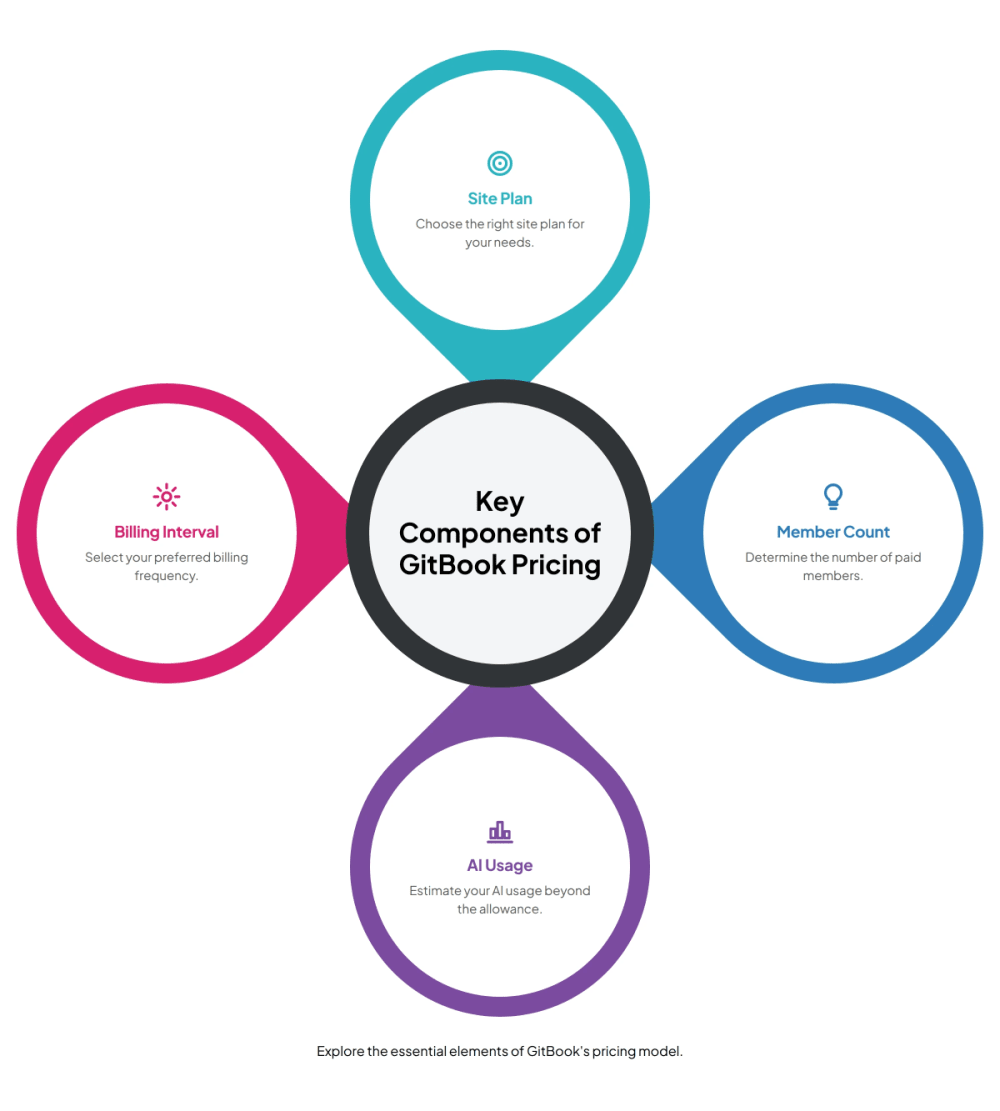
GitBook pricing combines a documentation-site fee, paid organization members, and any additional AI charges. For one Essential site and five paid members, the annual-billing rates produce a $125 monthly equivalent, or $1,500 for a full year before extra usage and taxes. The right budget starts with your publishing structure and required workflow, rather than the site price alone.
Checked November 9, 2026. This source-based guide uses GitBook's current public pricing and billing documentation. Calculations are illustrative scenarios, not quotes, observed customer bills, or hands-on product results. Hyperdocs publishes this guide and offers a competing documentation platform. No negotiated discounts or measured labor savings are assumed.
The annual-billing view on GitBook's pricing page lists Essential at $65 per site per month and Ultimate at $249, plus $12 per paid user per month. Free is positioned for individuals; Enterprise has custom pricing. Essential includes 2,000 monthly AI credits per site and Ultimate includes 10,000.
Source highlight: the public calculator combines the site plan with the user count. Treat that combination as the base subscription. A site price without the required collaborators leaves the rollout estimate incomplete.
First decide how many independently published sites your organization needs. List product brands, domains, audiences, and any separation required by governance. Do not assume every language or product version requires another paid site. Equally, do not assume a single site satisfies every domain or access requirement. Confirm the planned structure before purchasing.
GitBook's current billing policy lists monthly billing at $79 per Essential site or $299 per Ultimate site, plus $15 per member per month. It describes member-count adjustments and annual true-ups when subscriptions increase during an annual term.
Source highlight: a monthly equivalent under annual billing is a budgeting unit. It is not a promise that the base subscription is charged monthly. Keep the commitment, renewal timing, and ongoing usage charges separate in the approval request.
Count paid members once at the organization level in these examples. Do not multiply the same member list by every site. The scenarios assume all listed members are billable and remain for the entire modeled period. Confirm the actual billing count, roles, and contract with GitBook; a public reader and a workspace collaborator are different budgeting questions.
The official AI credits documentation describes a monthly allowance for each paid site and recurring credit packs. Assistant Ask and Chat use 20 credits per relevant question. Credit packs and usage are billed monthly even when the base subscription is annual.
Source highlight: credits measure billable AI activity, not ordinary pageviews. Forecast the specific AI task your readers or team will use. A documentation traffic forecast alone does not establish how many relevant questions will consume credits.
Compare the Documentation Workflow
Review Hyperdocs and GitBook against the contribution and maintenance work your team needs.
For a uniform plan, use: base monthly equivalent = site count × site rate + paid member count × member rate. For an annual estimate, multiply that result by 12. For mixed site plans, sum the individual site charges, then add the organization member charge once. Keep AI packs, variable usage, taxes, and service work on separate lines.
The following original scenarios use the published annual-billing rates. They assume a stable member count and no AI charge beyond the included allowance. They are arithmetic examples, not a recommendation to choose a particular plan.
Configuration | Essential monthly equivalent | Ultimate monthly equivalent |
1 site, 5 paid members | $125 |
Essential is 1 × $65 + 5 × $12 = $125 monthly equivalent, or $1,500 annually. Ultimate is 1 × $249 + 5 × $12 = $309 monthly equivalent, or $3,708 annually. Under monthly billing, the corresponding base amounts are $154 and $374. Use the interval you would actually buy when comparing quotes.
Essential is 3 × $65 + 10 × $12 = $315 monthly equivalent, or $3,780 annually. Ultimate is 3 × $249 + 10 × $12 = $867 monthly equivalent, or $10,404 annually. The corresponding monthly-billing amounts are $387 and $1,047. The member term is still added once.
Separate a site expansion from a hiring expansion. An additional site adds a site-plan charge; an additional billable member adds a member charge. Record both assumptions explicitly so a reviewer can reproduce the estimate without interpreting a blended per-person number.
Start with one site and one defined workload. If only Assistant questions consume the allowance, 2,000 credits divided by 20 gives 100 relevant questions; 10,000 divided by 20 gives 500. These are simplified capacities under the stated assumption. Other credit-consuming activity reduces what remains, and the division does not guarantee that every visitor question is billable or answered correctly.
For a hypothetical Essential site with 300 relevant questions in a month, the modeled requirement is 6,000 credits. Subtracting the included 2,000 leaves a 4,000-credit gap. The pricing page lists a recurring 5,000-credit pack at $47.50. With the earlier five-member example, that selected pack produces $172.50 for the monthly equivalent of base subscription plus pack.
If the same pack were purchased every month for 12 months, the modeled combined amount would be $2,070 for the year. That calculation assumes no additional charges and no changes in site count, seats, rates, or consumption. It describes one selected purchasing pattern, rather than an automatically optimized bill.
Do not upgrade solely because one allowance is larger. Check whether you need Ask, Chat, authenticated access, or another capability first. Extra credits do not by themselves establish entitlement to a feature excluded from the chosen plan. Ask GitBook to confirm how the allowance and selected pack apply to your exact configuration.
The pricing page describes AI auto-pause. GitBook's more detailed AI usage FAQ says usage can pause or continue according to billing settings. Verify the actual account setting, continuation rates, notifications, and who can change them. Do not treat the public allowance as a guaranteed spending cap.
Assign an owner to inspect usage early in the rollout and before each renewal. Record which actions use credits and which requirements depend on the reader-facing assistant. Test the experience when an allowance is exhausted so support knows what customers will see.
A complete rollout estimate also includes content cleanup, import validation, domain setup, contributor onboarding, and technical review. Use your own scoped hours or a contractor quote. Separate one-time migration from recurring administration and content maintenance; neither should disappear merely because hosting is managed.
Use the documentation migration checklist to identify URL mapping, cutover validation, and rollback tasks. Estimate those activities before approving an apparently small subscription saving.
Keep documentation accuracy in the budget. A stale onboarding instruction can interrupt a customer task and create support work. Someone still needs to identify release-related changes, verify examples, and approve publication. An AI answer feature cannot repair a missing source explanation by making the subscription more expensive.
Compare alternatives using the same site structure, collaborators, required capabilities, and review effort. A low starting price for another product is insufficient evidence of lower total cost. A higher subscription is also insufficient evidence of better outcomes. Keep any proposed savings separate from measured results.
Review how the estimate changes when the rollout expands. If a second product needs another published site but uses the same five collaborators, change only the site term until the membership list changes. If an engineer joins solely to review a release, confirm whether that role is billable before assigning a full-year seat. Keep a dated roster with the costing model and review access regularly. That makes the budget easier to explain without removing legitimate contributors merely to meet an arbitrary price target.
Help us understand your organizational needs.
What is your expected site count for GitBook?
Build the approval worksheet with five inputs: published sites by plan, paid members, billing interval, expected AI workload, and one-time implementation work. Put the source-check date beside each rate. Name the owner of any unconfirmed assumption instead of hiding it in a zero-cost line.
Before purchase, reconcile the estimate with the current checkout or written quote. Confirm member counts, site boundaries, required features, included credits, recurring pack choices, usage continuation settings, taxes, renewal dates, and any mid-term adjustment. Use actual contractual terms for enterprise or legacy accounts.
After launch, compare the first full invoice and usage report with the model. Identify whether a difference came from membership, site configuration, AI consumption, or proration. Update the specific driver rather than replacing the model with a single unexplained monthly number.
If the cost model exposes a workflow problem rather than a billing problem, use the GitBook alternatives shortlist to identify a small set of candidates. For a focused two-product evaluation, the GitBook versus Mintlify guide covers editing and maintenance tradeoffs. This pricing guide leaves those product verdicts to their existing owners.
Choose the least costly configuration that meets the documented requirements and leaves your team able to maintain accurate documentation. Keep the arithmetic reproducible, the usage policy explicit, and the next review date attached to the budget.
At the checked annual-billing rates, one Essential site plus five paid members is $125 monthly equivalent, or $1,500 annually. Ultimate is $309 monthly equivalent, or $3,708 annually. Extra usage, taxes, and implementation work are excluded.
Its current paid self-serve model combines site-plan charges with organization member charges. Count the sites by plan and the billable member list separately. Confirm your actual member count and contract before purchase.
GitBook's current plan documentation says Premium was renamed Essential with the same features. Use current plan and billing documentation when evaluating a quote instead of relying on an older review.
GitBook documents credit packs as recurring monthly purchases. Packs and usage remain monthly charges even when site and member subscriptions are annual. Verify the selected pack and billing configuration.
No. Dividing by 20 gives a simplified capacity of 100 relevant questions only when no other activity consumes credits. It does not guarantee answer quality, billing treatment for every request, or remaining capacity.
Check the actual billing setting. The pricing page describes auto-pause, while the detailed usage FAQ says usage may pause or continue according to account configuration. Confirm continuation rules and rates before launch.
Subscribe to Our Newsletter
Stay up to date with our latest news and updates.
3 sites, 10 paid members | $315 | $867 |